
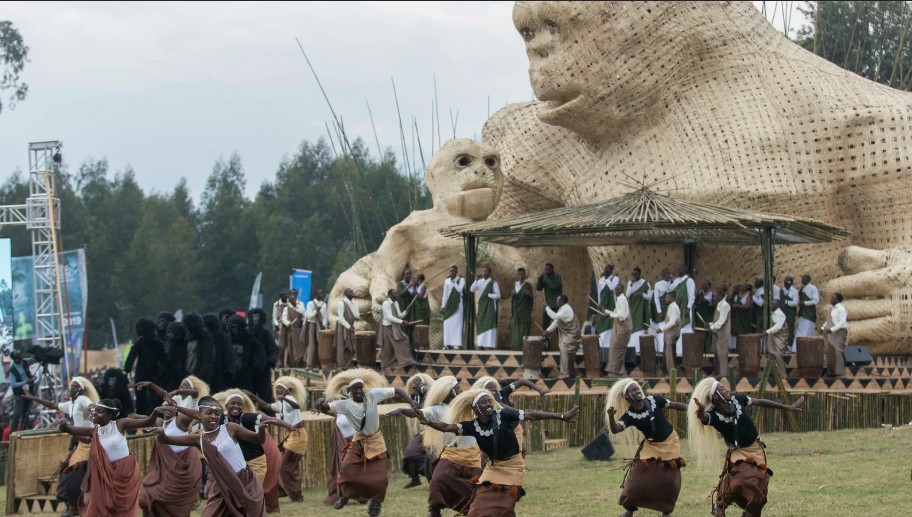
The hills of Kinigi in Rwanda once again became the centre of global attention on 4th September,2026 as Rwanda hosted the 21st Edition of Kwita Iziina, the country’s internationally recognised mountain gorilla naming ceremony. What began as a culturally rooted ceremony has grown into one of Africa’s most prominent conservation events, bringing together political leaders, conservationists, business executives, athletes, entertainers, filmmakers, tourists and local communities.
The 2026 edition continued that tradition, combining the naming of baby mountain gorillas with discussions and activities around conservation, tourism, community development, culture and entertainment.
The main ceremony was held at the foothills of Volcanoes National Park in Kinigi, Musanze District under the theme “Conservation is Life: Sustaining the future.” The message behind the theme was particularly appropriate because the ceremony was not simply about giving names to new-born gorillas.
It was a public reminder that the survival of mountain gorillas depends on the continued cooperation of communities, governments, researchers, veterinarians, rangers, tourism operators, conservation organisations and international partners. The 2026 celebration therefore presented Rwanda’s gorilla conservation story as a broader story about people, nature and sustainable development.
The meaning behind Kwita Iziina.
Kwita Iziina literally refers to the act of giving a name. Its roots are connected to the Rwandan cultural practice of naming children in the presence of family members and the wider community. The same idea has been adapted to mountain gorilla conservation. A baby gorilla is not treated merely as another animal born in the forest; giving it a name symbolically gives it an identity and connects its story to the people who have committed themselves to protecting the species.
Since the ceremony became an official annual event in 2005, hundreds of mountain gorillas have received names through Kwita Iziina. With the addition of the 22 gorillas named in 2026, the cumulative number reached 460. The ceremony has consequently developed into much more than a one-day gathering. It has become an international platform through which Rwanda communicates its conservation ambitions and celebrates the people whose work makes the survival of mountain gorillas possible.
The 2026 edition was especially significant because it highlighted the recovery of the mountain gorilla population. Rwanda’s Prime Minister, Dr. Justine Nsengiyunva pointed to the dramatic change from the situation in the early 1980’s when the Virunga Massif had only about 250 mountain gorillas.
Today, more than 1,000 mountain gorillas are estimated to live in the wild across the wider population including more than 600 in the Virunga Massif. The improvement demonstrates how sustained conservation, veterinary care, scientific research, anti-poaching work, responsible tourism and community participation can produce measurable results.
A week of activities rather than a single ceremony.
Although the gorilla ceremony was the central attraction, Kwita Iziina 2026 was organised as a much broader programme. Activities surrounding the main event brought together conservation, tourism, community development and entertainment.
One of the notable initiatives was the ground-breaking of the Smart Green Village in Kinigi. The project formed part of the wider Volcanoes Community Resilience Project and reflected Rwanda’s effort to connect environmental protection with the well-being of people living around protected areas.
The wider programme is expected to contribute to improved livelihoods while strengthening the relationship between communities and the national park. Rwanda has also outlined plans to expand Volcanoes National Park by approximately 3740 hectares and establish substantial buffer zones around the protected areas.
The programme also included the screening of A Gorilla Story in Musanze. The documentary presented in Kinyarwanda gave local audiences and opportunity to engage with the story of mountain gorilla conservation and the history of the work carried around the Virunga ecosystem.
The presence of conservation storytelling within the Kwita Iziina programme showed that the event is not limited to ceremonies and speeches; it also seeks to educate audiences about why gorillas matter and why their habitat must be protected.
The Namer Gorilla Trekking Experience.
Another important activity was the Namer Gorilla Trekking Experience. Some of the personalities invited to name the gorillas had an opportunity to experience mountain gorilla trekking in Volcanoes National Park before the main ceremony. This gave them a direct encounter with the environment they were celebrating. Instead of hearing about gorilla conservation only from a stage, they could experience the forest and appreciate the tourism experience that has helped make gorilla conservation an important part of Rwanda’s economy and international identity.
The celebration also included a Community Concert in Musanze on the eve of the naming ceremony. This brought music and entertainment into the wider programme and allowed local residents to participate in the celebrations. The community aspect was important because Kwita Iziina is increasingly designed not simply as an international tourism event but also as a celebration for Rwandans themselves.
The 22 Baby Gorillas and their names.
The emotional centre of the 2026 event was the naming of 22 baby mountain gorillas. Each name carried a meaning or story connected to the animal, its family, conservation or Rwanda’s wider environmental ambitions.
Among the names was Ishakwe meaning “determination.” The name was given to a female gorilla from the Muhoza family. It represented the determination required to protect biodiversity and maintain Rwanda’s conservation achievements.
Another gorilla was named Mukondo meaning “starting point or source.” The name reflected the idea that protecting mountain gorillas can also contribute to protecting the larger ecosystem on which numerous other species and communities depend.
A baby from the historic Susa family received the name Shikama meaning “stand strong.” The name was particularly symbolic because the Susa family has a long history within Rwanda’s gorilla conservation story.
Inkera, meaning “traditional celebration,” was another name memorable name. The gorilla was born shortly before Umuganura, Rwanda’s traditional harvest celebration making the name a bridge between conservation and Rwandan cultural heritage.
Other names included Rugamba meaning “fighter”; Mucyo, meaning “light” and Ngabonzima meaning “protector.” The names demonstrate how the ceremony combines the personal identity of individual gorillas with larger conservation messages.
The International celebrities who attended.
One of the biggest attractions of Kwita Iziina 2026 was the extraordinary range of internationally recognised personalities who participated as namers or guests. The list cut across sport, entertainment, conservation, tourism, business and philanthropy.
Among the most recognisable sporting figures was Patrice Evra, the former Manchester United and France captain. Evra’s presence enormous international sporting visibility to the ceremony. His career included five Premier League titles with Manchester United and a UEFA Champions League triumph, while he also earned 81 appearances for France. His participation demonstrated the way Rwanda has used global sporting personalities to amplify conservation messages beyond traditional environmental audiences.
Another major football personality was Mamadou Sakho, the former France international who played for clubs including Paris-Saint Germain, Liverpool and Crystal Palace. James Chester, the former Aston Villa captain and Wales international, also participated. Their presence gave the ceremony a strong connection to European football and its enormous global audience.
The sporting representation extended beyond football. Mutaz Essa Barshim, the celebrated Qatari high jumper, participated as one of the namers. Barshim is an Olympic Champion and three-time world champion and is one of the most accomplished high jumpers of his generation. David Lappartient, President of the Union Cycliste Internationale and international Olympic Committee member was also among the prominent figures connected to the ceremony.
Film, conservation and global environmental storytelling.
The entertainment and conservation world were represented by internationally respected filmmaker Alastair Forthergill. He is widely recognised for his work on major natural history productions such as a Planet Earth and Blue Planet as well as A Gorilla Story. His involvement was particularly fitting because his career has helped millions of people around the world understand wildlife and the importance of protecting natural habitats.
Rwanda’s own creative industry was represented by personalities including Marie-Clementine Dusabejambo a celebrated Rwandan filmmaker whose work has gained international recognition. Her presence showed that Kwita Iziina is not only a platform for international stars; it also provides space for Rwandan creative professionals to represent their country and its stories.
Another prominent Rwandan personality was gospel musician Israel Mbonyi. His participation brought the country’s contemporary music scene into the conservation. Rather than treating conservation as a subject belonging exclusively to scientists and government officials, the event showed that musicians and artists can also become ambassadors for environmental protection.
Tourism and Business leaders.
Kwita iziina 2026 also attracted major figures from international tourism and business. Shaikha Al Nuwais, the incoming Secretary General of UN Tourism, was among the most significant guests. Her expected leadership of the global tourism body gave her participation particular importance because Rwanda’s gorilla tourism model is closely connected to sustainable tourism and destination development.
Miguel Angel Gil Marin, CEO and majority shareholder of Atletico de Madrid, was another high-profile participant. His presence added an international business and sports dimension to the ceremony.
The business community was further represented by Dominic Barton Chairman of Rio Tinto and Leapfrog Investments and former Global Managing Partner of McKinsey and Company. Paul Dan forth, President of CAA Sports and Ahmed Sadek Elsewedy Chairman of Elsewedy Electric, were also among the prominent namers.
These personalities were significant because conservation requires resources. Protecting a species cannot depend only on enthusiasm; it requires financing, infrastructure, scientific research, community programmes, tourism management and long-term investment. Their involvement therefore connected the gorilla story with the wider question of sustainable development.
Kenza Ameloot.
Another personality who attracted attention was Kenza Ameloot, miss Belgium 2024 and a woman of Rwanda heritage. Her participation provided a different dimension to the event. As a beauty queen with an international platform and a personal connection to Rwanda, she represented the way the country’s conservation story can connect with people of Rwandan heritage living abroad.
Her presence also reflected a wider characteristic of Kwita Iziina: the ceremony is increasingly a meeting point for people who have different professional backgrounds but share an interest in Rwanda, conservation, tourism and social development.
Music gave the ceremony a festive atmosphere.
While conservation remained the heart of the occasion, music ensured that Kwita Iziina did not feel like a conventional environmental conference. The 2026 ceremony featured several of Rwanda’s popular performers, including The Ben, Kivumbi King, Ariel Wayz, Juno Kizigenza, Bwiza, Riderman, Chriss Eazy, Ken Sol and Senderi International Hit. The Ben served as one of the major musical attractions and performed for the audience gathered in Kinigi.
The presence of these artists helped turn the naming ceremony into a national cultural celebration. Music provided a way for younger audiences and ordinary members of the public to connect with the event while reinforcing the idea that conservation can be celebrated through culture.
The following day, the celebrations moved from Kinigi to Kigali for the Kwita Iziina Concert at BK Arena. Nigerian Afrobeat superstar Rema was the headline performer. The concert also featured Rwandan artists and DJs including Kivumbi King, Keny Sol, Sara Phenom, DJ Senshi and DJ Manaud.
Rema’s appearance gave the celebration a major continental entertainment dimension. The Nigerian artist is one of Africa’s most internationally recognised young musicians and his participation connected the conservation event with the rapidly expanding African entertainment industry.
The concert ultimately provided a spectacular closing chapter to the 2026 celebrations, bringing together music fans, local residents and people who had travelled to Rwanda for Kwita Iziina. Reports from the concert described performances by Rwandan artists before Rema took the stage, turning the conclusion of the week into a major celebration of African music and cultural.
The community remained at the heart of the celebration.
Despite the celebrity appearances, one of the most important aspects of Kwita Iziina 2026 was the recognition that the conservation cannot succeed without communities living near protected areas. Rwanda’s tourism
Rwanda’s revenue sharing programme directs 10% of national park tourism revenues back to communities surrounding protected areas. According to official information, more than RWF 23 billion has already supported almost 1300 community projects including schools, health facilities, water infrastructure and livelihoods initiatives.
This is primarily important around Volcanoes National Park because the success of gorilla conservation is closely connected to the relationship between people and the forest. When communities see tangible benefits from tourism and conservation, they have stronger incentives to support the protection of wildlife.
Kwita Iziina therefore sends a message that gorilla conservation is not simply about keeping animals inside protected areas. It is about creating conditions in which wildlife, tourism and human development can exist alongside one another.