
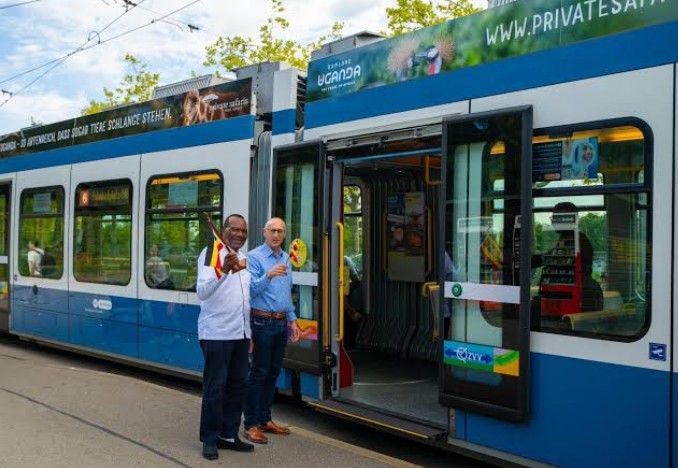
Uganda has taken its tourism story beyond traditional travel affairs and brochures by putting the country’s attractions directly into the daily lives of people in Zurich, Switzerland. On September 16, 2026, trams travelling through Switzerland’s largest city began carrying colourful advertisements showcasing Uganda’s wildlife, landscapes and natural experiences.
The campaign brings a different energy to Uganda’s international tourism marketing. Instead of waiting for potential visitors to search for an African holiday or attend a tourism exhibition, Uganda is taking its destination message to commuters as they move around one of Europe’s major urban centres.
The initiative is being implemented by the embassy of Uganda in Switzerland in partnership with private safaris, a travel specialist focused on African destinations in the Swiss market.
The campaign also follows Uganda’s participation in Zurich’s FESPO and Golfmesse tourism exhibition earlier in 2026. Uganda established its first national pavilion at the event creating an opportunity to introduce its tourism products to Swiss travellers and travel industry professionals.
Uganda Brings the Pearl of Africa to Zurich.
Zurich provides an unusual but powerful setting for destination marketing. It is a busy city where people regularly use public transport for work, shopping, business and leisure. By placing Uganda’s tourism imagery on trams, the campaign turns an ordinary journey into an opportunity to discover a completely different destination.
A commuter heading across Zurich can now encounter images associated with Uganda’s natural attractions without deliberately looking for tourism information. Wildlife, scenic landscapes and outdoor experiences become part of the visual environment of the city.
That approach gives the campaign a broad reach. The message is not restricted to people who have already decided to visit Africa. It can also reach residents who may have considered destinations such as Kenya, Tanzania and south Africa but have not yet though seriously about Uganda.
For Uganda, the distinction matters. International travellers often know individual African destinations better than they know the wider range of experiences available across the continent. A campaign that repeatedly introduces Uganda to a new audience can help build recognition before a traveller begins making specific holiday plans.
From Zurich Trams to Uganda’s Wildlife.
Wildlife remains one of Uganda’s strongest tourism attractions, and the Zurich campaign places nature at the centre of the visual message.
Uganda offers opportunities to see animals such as elephants, lions, buffaloes, giraffes, chimpanzees and mountain gorillas. Different national parks provide different experiences, allowing visitors to move beyond the traditional idea of a single safari.
Murchison Falls National Park combines wildlife viewing with the dramatic Nile and the powerful Murchison falls. Queen Elizabeth National Park offers savannah landscapes, wildlife and the Kazinga channel while Kidepo Valley National Park gives travellers an opportunity to explore a remote and distinctive part of north eastern Uganda.
The country’s forest destinations add another dimension. Kibale National Park is widely associated with chimpanzee experiences while Bwindi Impenetrable National Park remains one of the country’s signature destinations for mountain gorilla trekking.
For travellers attracted to mountains, Uganda can also showcase the Rwenzori Mountains and the Virunga landscapes around Mgahinga. These experiences broaden the country’s appeal beyond conventional game drives.
Gorilla Trekking can Become a Major Attraction.
Among the experiences Uganda can promote to the Swiss market, gorilla trekking has a particularly strong place in the country’s tourism identity.
The experience takes visitors into the forest under the guidance of trained trackers and guides. Rather than watching wildlife from the vehicle, travellers move through the natural environment in search of the habituated mountain gorilla groups.
The experience combines wildlife, physical adventure and forest exploration. It also requires careful planning because trekking permits, accommodation, transport and park arrangements must be organised in advance.
For international visitors, this type of experience can become the centrepiece of a much longer Uganda holiday. A traveller can spend time in Bwindi before continuing to Queen Elizabeth National Park, Kibale, Lake Bunyonyi and other destinations.
This makes gorilla tourism important not only because of the trekking experience itself but also because it can connect different parts of the Ugandan tourism economy.
Zurich Station Adds Another Layer to the Campaign.
The tram advertising did not operate alone. Uganda has also launched a digital promotion at Zurich main train station on September 1, 2026.
According to Uganda’s embassy, a video showcasing the country’s tourism offering appears on advertising screens at the station every 20 to 30 minutes. The combination of the station screens and tram branding gives Uganda repeated exposure in different parts of Zurich’s public transport environment.
The strategy is significant because repetition can help a destination become familiar to an audience. A person may first see Uganda’s tourism message on a station screen and later encounter the country’s images on a tram.
The campaign therefore creates several opportunities for recognition rather than relying on advertisement seen once.
Building on Uganda’s Zurich Tourism Presence.
The tram campaign follows a series of efforts to increase Uganda’s visibility in Switzerland.
Earlier in January and February 2026, Uganda participated in FESPO and Golfmesse in Zurich. The country’s national pavilion brought together government officials, tourism operators and other stakeholders to present Uganda’s products to the Swiss market. The event more than 42000 visitors and featured more than 500 exhibitors, according to Uganda’s Ministry of Foreign Affairs.
The participation gave Ugandan tourism businesses an opportunity to interact directly with potential travellers and industry players. The later tram campaign takes that visibility beyond an exhibition venue and into the wider city.
Together, these activities show more sustainable effort to introduce Uganda to Swiss travellers.